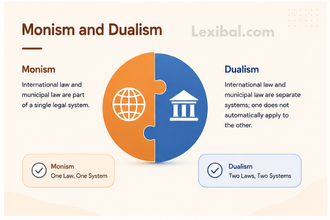





Transformation and Incorporation are two methods through which rules of International Law, particularly treaty obligations, may become applicable within the domestic legal system of a State. The concepts are closely associated with the Monism and Dualism debate concerning the relationship between International Law and Municipal Law.
- Meaning of Transformation
- Characteristics of Transformation
- Meaning of Incorporation
- Characteristics of Incorporation
- Transformation vs Incorporation
- Transformation in a Dualist System
- Incorporation in a Monist System
- Treaty Implementation
- Self-Executing and Non-Self-Executing Treaties
- Position in India
- Indian Judicial Approach
- Important Indian Cases
- Transformation and Incorporation in India
- Importance of Transformation
- Importance of Incorporation
- Limitations of Transformation
- Limitations of Incorporation
- Transformation vs Incorporation: Exam Comparison
- Common Confusions
- Relationship with Monism and Dualism
- Topic at a Glance
- Quick Revision
- Conclusion
Under a dualist approach, international and domestic law are treated as separate legal systems. Therefore, an international obligation may require a process through which it is introduced into domestic law before domestic courts can apply it. Transformation and Incorporation describe two different approaches to this process.
Meaning of Transformation
Transformation means that an international legal rule is converted into a corresponding rule of domestic law through an appropriate domestic legislative process.
Under this approach, the international rule does not automatically operate as domestic law.
The State must enact domestic legislation that gives the international obligation a domestic legal form.
Basic Process
International obligation → Domestic legislation → Domestic legal rule
For example, if a State becomes party to a treaty concerning a particular subject, the legislature may enact an Act reproducing or implementing the relevant treaty obligations within the domestic legal system.
The domestic court then applies the domestic legislation rather than directly applying the treaty as international law.
Characteristics of Transformation
Transformation generally involves:
- separation between international and domestic law;
- legislative implementation;
- conversion of international obligations into domestic legal rules;
- application of domestic legislation by domestic courts;
- greater involvement of the legislature.
The international obligation and the domestic rule created to implement it are therefore treated as legally distinct.
Meaning of Incorporation
Incorporation means that an international legal rule is introduced into the domestic legal system without necessarily being transformed into an entirely new domestic rule.
Under incorporation, an international rule may become part of domestic law through the constitutional or legal mechanism recognised by that State.
The domestic court may therefore apply the incorporated international rule directly.
Basic Process
International rule → Incorporation into domestic law → Domestic application
The precise mechanism depends upon the constitutional system of the State.
Characteristics of Incorporation
Incorporation generally involves:
- recognition of international law within the domestic legal system;
- less need to reproduce the international rule in separate legislation;
- possible direct application by domestic courts;
- reliance upon constitutional or judicial rules governing the domestic status of international law.
Transformation vs Incorporation
| Point | Transformation | Incorporation |
|---|---|---|
| Basic idea | International rule is converted into domestic law | International rule becomes part of domestic law |
| Method | Usually requires domestic legislation | May operate through constitutional recognition |
| Domestic rule | A corresponding domestic rule is created | International rule may be applied domestically |
| Role of legislature | Generally significant | May be limited or unnecessary depending on the system |
| International and domestic rule | Treated as separate rules | International rule may retain its character |
| Association | Strongly associated with dualism | Often associated with monist approaches |
Transformation in a Dualist System
Transformation is closely connected with the dualist theory.
Since international and domestic law are regarded as separate systems, an international obligation cannot automatically operate within domestic law.
The State therefore transforms the international obligation into domestic law.
For example:
Treaty concluded internationally
↓
Domestic legislature passes implementing legislation
↓
Domestic legal obligation is created
↓
Domestic courts apply the legislation
This ensures that domestic courts enforce a rule that forms part of the domestic legal system.
Incorporation in a Monist System
Incorporation is more closely associated with monist approaches.
Where the constitutional system permits international law to become part of domestic law directly, an international rule may be applied by domestic courts without a separate legislative transformation.
However, whether a treaty is directly enforceable may still depend upon:
- constitutional provisions;
- wording of the treaty;
- judicial interpretation;
- whether the treaty provision is sufficiently precise;
- whether the provision is considered self-executing.
Therefore, monism does not automatically mean that every international rule is directly enforceable.
Treaty Implementation
The distinction between transformation and incorporation is particularly important in relation to treaties.
Transformation
A State becomes internationally bound by a treaty and subsequently adopts domestic legislation implementing the treaty.
Incorporation
The constitutional system permits the treaty or relevant international rule to become part of domestic law through an established incorporation mechanism.

Self-Executing and Non-Self-Executing Treaties
The concepts of transformation and incorporation are also connected with the distinction between self-executing and non-self-executing treaty provisions.
Self-Executing Treaty Provision
A treaty provision that is capable of being applied domestically without further legislative implementation, subject to the constitutional system.
Non-Self-Executing Treaty Provision
A treaty provision that requires domestic legislation before it can be enforced by domestic courts.
Therefore:
Self-executing → May be directly applicable
Non-self-executing → Domestic implementation may be required
The exact meaning and application of these concepts differ between legal systems.
Position in India
India is generally regarded as following a predominantly dualist approach concerning treaties.
The Constitution provides mechanisms for implementing international agreements through domestic legislation.
Article 51(c)
Article 51(c) directs the State to foster respect for:
“international law and treaty obligations in the dealings of organised peoples with one another.”
This demonstrates the constitutional recognition of international law and treaty obligations.
Article 253
Article 253 is particularly important.
It empowers Parliament to make laws for implementing:
- treaties;
- agreements;
- conventions;
- decisions made at international conferences or bodies.
This provision provides an important constitutional mechanism for giving international commitments domestic legal effect.
Indian Judicial Approach
Indian courts have recognised the importance of international law while maintaining the distinction between international obligations and domestic enforceability.
Where there is no conflict with domestic law, international law may be used as an interpretative aid.
However, a treaty does not ordinarily become enforceable as domestic law merely because the executive has entered into it internationally.
Important Indian Cases
Maganbhai Ishwarbhai Patel v. Union of India, 1969
The Supreme Court considered the relationship between international agreements and domestic law.
The case is important for understanding the constitutional framework concerning treaty implementation in India.
The Court recognised the distinction between international obligations and the need for domestic legislative action where implementation affects domestic law.
Jolly George Varghese v. Bank of Cochin, 1980
The Supreme Court considered an international covenant alongside domestic law.
The Court emphasised that international obligations cannot automatically override domestic legislation.
The case demonstrates the importance of domestic legal implementation in giving international obligations enforceable effect.
Gramophone Company of India Ltd. v. Birendra Bahadur Pandey, 1984
The Supreme Court considered the relevance of international law within the Indian legal system.
The Court recognised that principles of international law may be considered by Indian courts where they are consistent with domestic law.
Vishaka v. State of Rajasthan, 1997
The Supreme Court relied upon international conventions and international norms concerning women’s rights while developing guidelines in an area where domestic legislation was inadequate.
The case demonstrates that international law may influence domestic judicial interpretation even where direct treaty enforcement is not available.
Transformation and Incorporation in India
India does not fit neatly into a pure transformation or pure incorporation model.
The Indian position varies depending upon the type of international rule involved.
Treaties
Treaties generally require appropriate domestic implementation where their provisions need to operate as enforceable domestic law.
Customary International Law
Indian courts may recognise customary international law where it is consistent with domestic legislation and constitutional principles.
International Human Rights Norms
International human rights instruments may be used as interpretative aids where domestic law is ambiguous or incomplete, provided there is no inconsistency with domestic law.
Importance of Transformation
Transformation provides several advantages.
Legislative Control
The legislature participates in giving domestic effect to international obligations.
Constitutional Protection
It ensures that international commitments operate within the constitutional structure of the State.
Legal Certainty
Domestic legislation provides a clear legal basis for courts and citizens.
Democratic Accountability
The domestic legislature can examine the consequences of implementing international obligations.
Importance of Incorporation
Incorporation provides different advantages.
Direct Application
International rules may be applied domestically without reproducing them in separate legislation.
Efficiency
The domestic implementation process may be faster.
International Consistency
The domestic legal system may apply the international rule in substantially the same form as it operates internationally.
Protection of International Obligations
International commitments may receive stronger domestic effect.
Limitations of Transformation
- Implementation may be delayed.
- The legislature may modify the wording of the international obligation.
- International obligations may remain unenforceable domestically until legislation is enacted.
- Differences may emerge between international and domestic rules.
Limitations of Incorporation
- Direct application may raise constitutional questions.
- Not every international rule is sufficiently precise for direct application.
- Some treaty provisions may require further legislative action.
- Constitutional systems may impose limitations on direct applicability.
Transformation vs Incorporation: Exam Comparison
| Basis | Transformation | Incorporation |
|---|---|---|
| Concept | Converts international law into domestic law | Admits international law into domestic law |
| Legal system | Usually dualist | More commonly associated with monist systems |
| Legislation | Generally required | May not be required |
| International rule | Becomes a separate domestic rule | May retain its international character |
| Domestic court | Applies domestic implementing law | May apply the incorporated international rule |
| Main emphasis | Separation | Integration |
| Example | Treaty implemented through an Act | Treaty directly applicable under constitutional law |
Common Confusions
Are transformation and incorporation the same?
No.
Transformation converts an international rule into domestic law, whereas incorporation allows the international rule to become part of domestic law through an established legal mechanism.
Is transformation always required in dualist States?
As a general principle, domestic implementation is required for an international obligation to operate as enforceable domestic law, although the precise constitutional mechanism varies between States.
Does incorporation mean every treaty automatically applies domestically?
No.
Domestic applicability depends upon the constitutional system and the nature of the treaty provision.
Does monism always mean direct application?
No.
Constitutional provisions may still impose conditions on the domestic effect of particular treaties.
Does dualism mean international law has no domestic relevance?
No.
International law may influence legislation and judicial interpretation even where domestic implementation is required.
Can Indian courts use international law without implementing legislation?
Yes, in appropriate circumstances.
Indian courts may use international law and international conventions as interpretative aids where they are consistent with domestic law.
Can a treaty override Indian legislation automatically?
Generally, no.
International treaty obligations do not automatically override domestic legislation without an appropriate domestic legal basis.
Relationship with Monism and Dualism
The concepts can be understood together:
Monism
International and domestic law are parts of one legal system.
↓
Incorporation
International rules may become part of domestic law through the constitutional system.
Dualism
International and domestic law are separate legal systems.
↓
Transformation
International rules are converted into domestic rules through the appropriate domestic process.
This is a useful framework for understanding the theoretical distinction, although actual States may combine elements of both approaches.
Topic at a Glance
| Point | Position |
|---|---|
| Subject | Transformation and Incorporation |
| Main issue | Domestic implementation of international law |
| Transformation | International rule converted into domestic law |
| Incorporation | International rule admitted into domestic legal system |
| Main association | Transformation → Dualism |
| Main association | Incorporation → Monism |
| Treaty relevance | Particularly important |
| India | Predominantly dualist approach to treaties |
| Article 51(c) | Respect for international law and treaty obligations |
| Article 253 | Parliamentary power to implement international agreements |
| Important cases | Maganbhai, Jolly George Varghese, Gramophone Company, Vishaka |
| Related concept | Self-executing and non-self-executing treaties |
Quick Revision
- Transformation means converting an international rule into a domestic legal rule through the appropriate domestic process.
- Incorporation means bringing an international rule into the domestic legal system without necessarily transforming it into a separate domestic rule.
- Transformation is closely associated with Dualism.
- Incorporation is commonly associated with Monism.
- Treaty implementation is the most important practical context for both concepts.
- Under transformation, domestic legislation generally gives the international obligation domestic legal effect.
- Under incorporation, international rules may operate domestically through constitutional recognition.
- Self-executing treaty provisions may be directly applicable domestically.
- Non-self-executing provisions generally require domestic implementation.
- India follows a predominantly dualist approach concerning treaties.
- Article 51(c) recognises the importance of international law and treaty obligations.
- Article 253 empowers Parliament to make laws implementing treaties and international agreements.
- Maganbhai Ishwarbhai Patel is important for treaty implementation.
- Jolly George Varghese demonstrates the relationship between international obligations and domestic law.
- Gramophone Company concerns the use of international law within the Indian legal system.
- Vishaka demonstrates the use of international norms as an interpretative aid.
- Transformation and incorporation are theoretical categories; actual constitutional systems may combine elements of both.
- International law may bind a State internationally even when it has not yet been incorporated or transformed into domestic law.
Conclusion
Transformation and incorporation explain how international legal rules become effective within domestic legal systems. Transformation involves converting an international obligation into a domestic legal rule, generally through legislation, and is closely associated with dualism. Incorporation allows international rules to become part of domestic law through the constitutional mechanism of the State and is more closely associated with monism. The distinction is particularly significant in treaty implementation. India follows a predominantly dualist approach, with Article 253 providing Parliament with the power to implement international agreements through legislation. At the same time, Indian courts may use international law as an interpretative aid where it is consistent with domestic law. The actual operation of either approach ultimately depends upon the constitutional structure and judicial practice of the particular State.