




Monism and Dualism are two major theories explaining the relationship between International Law and Municipal (Domestic) Law. The central question is whether international law and domestic law form part of a single legal system or whether they operate as separate legal systems.
- Meaning of Monism
- Major Thinkers Associated with Monism
- Types of Monist Approaches
- Meaning of Dualism
- Major Thinkers Associated with Dualism
- Basis of the Dualist Theory
- Monism vs Dualism
- Difference in Treaty Implementation
- Conflict Between International and Domestic Law
- International Responsibility and Domestic Law
- Monism and Direct Effect
- Position in India
- Indian Judicial Approach
- Important Indian Cases
- Advantages of Monism
- Disadvantages of Monism
- Advantages of Dualism
- Disadvantages of Dualism
- Modern Approach
- Important Distinctions
- Common Confusions
- Topic at a Glance
- Quick Revision
- Conclusion
The debate is particularly important when an international obligation conflicts with a rule of domestic law. It also helps explain how treaties and customary international law become applicable within a State’s domestic legal system.
Meaning of Monism
Monism is the theory that International Law and Municipal Law form part of one unified legal system.
According to the monist approach, international and domestic law are not completely separate systems. They are different components of a single legal order.
Therefore, an international legal rule may, depending upon the constitutional system of the State, operate within the domestic legal order without requiring a separate act of transformation.
Basic Idea
International Law + Municipal Law = One Legal System
Under monism:
- international law and domestic law are part of a unified legal order;
- international rules may operate directly within domestic law;
- domestic courts may be able to apply international rules;
- the relationship between the two depends upon the particular constitutional system.
Major Thinkers Associated with Monism
Hans Kelsen
Hans Kelsen is one of the most prominent theorists associated with the monist approach.
Kelsen developed a Pure Theory of Law based upon a hierarchical structure of legal norms.
He viewed international law and municipal law as components of a single legal system.
According to Kelsen’s approach, the validity of legal norms can ultimately be understood within a unified normative structure.
Georges Scelle
Georges Scelle also supported a monist conception of international law.
He emphasised the unity of the international and domestic legal orders and rejected the idea that States could be treated as completely isolated legal entities.
Types of Monist Approaches
Monism does not necessarily mean that every monist theorist agrees about which legal system has ultimate supremacy.
Monism with Primacy of International Law
Under this approach, international law has superior authority over domestic law.
Where the two conflict, international law should prevail.
Kelsen is particularly associated with approaches giving international law a higher normative position.
Monism with Primacy of Municipal Law
Some monist approaches give greater importance to domestic constitutional law.
Under this approach, domestic law may determine the extent to which international rules operate internally.
Therefore, monism does not automatically produce one uniform answer regarding supremacy.
Meaning of Dualism
Dualism is the theory that International Law and Municipal Law are two separate and distinct legal systems.
International law regulates relations primarily at the international level, while domestic law regulates relationships within the State.
According to dualism, an international rule does not automatically become part of domestic law merely because the State has accepted it internationally.
It must generally be incorporated or transformed into domestic law through the appropriate constitutional process.
Basic Idea
International Law ≠ Municipal Law
Under dualism:
- international and domestic law are separate systems;
- they have different sources;
- they operate in different spheres;
- international obligations do not automatically become domestic law;
- domestic legislation may be required before an international rule can be enforced by domestic courts.
Major Thinkers Associated with Dualism
Heinrich Triepel
Heinrich Triepel is one of the principal theorists associated with dualism.
He argued that international law and municipal law are separate legal orders based upon different sources and relationships.
Triepel emphasised the importance of common will (Gemeinwille) in international law.
Dionisio Anzilotti
Dionisio Anzilotti also supported the dualist approach.
He emphasised the distinction between the international and domestic legal orders and the role of State consent in international obligations.
Basis of the Dualist Theory
Dualism is generally based on differences between international and municipal law.
Difference in Sources
International law arises from sources such as:
- treaties;
- customary international law;
- general principles of law.
Domestic law arises from:
- constitutions;
- legislation;
- regulations;
- judicial decisions;
- other domestic legal sources.
Difference in Subjects
International law primarily regulates:
- States;
- international organisations;
- and, in certain areas, individuals and other entities.
Domestic law primarily regulates:
- individuals;
- companies;
- institutions;
- government authorities;
- other entities within the State.
Difference in Scope
International law regulates international relations, while municipal law generally governs matters within the domestic legal order.
Difference in Enforcement
International law and domestic law have different institutional mechanisms for implementation and enforcement.
Monism vs Dualism
| Point | Monism | Dualism |
|---|---|---|
| Legal systems | One unified system | Two separate systems |
| Relationship | International and domestic law form one legal order | International and domestic law operate independently |
| International rules domestically | May operate directly, depending on constitutional system | Generally require incorporation/transformation |
| Treaty implementation | May not require separate legislation in some systems | Usually requires domestic implementation |
| Conflict | May involve hierarchy between norms | Domestic and international rules operate in separate spheres |
| Key thinkers | Hans Kelsen, Georges Scelle | Heinrich Triepel, Dionisio Anzilotti |
Difference in Treaty Implementation
The distinction becomes particularly important with treaties.
Under Monism
Once the State validly accepts a treaty, the treaty may become part of the domestic legal order without requiring separate implementing legislation, depending upon the constitutional framework.
Under Dualism
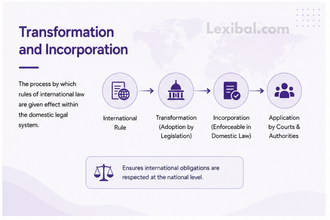
The treaty creates obligations at the international level, but domestic legislation is generally required before its provisions can be directly enforced by domestic courts.
Thus:
Monism → International obligation may have direct domestic effect
Dualism → International obligation generally requires domestic incorporation
However, actual constitutional systems can be more complicated than these simplified descriptions.
Conflict Between International and Domestic Law
One of the most important questions is what happens when international law conflicts with domestic law.
Monist Approach
Where international law has primacy, the international rule may prevail over inconsistent domestic legislation.
Where domestic constitutional law gives priority to domestic rules, the outcome may differ.
Dualist Approach
International and domestic law operate on different planes.
A State may remain internationally responsible for violating international law even if its domestic law permits or requires the conduct.
Therefore:
A State generally cannot rely on its domestic law as a justification for failing to perform an international obligation.
This principle is particularly important in treaty law.
International Responsibility and Domestic Law
The distinction between international and domestic legal orders does not mean that domestic law can override international obligations.
A State may have constitutional or legislative rules preventing domestic authorities from implementing an international obligation.
However, that does not necessarily eliminate the State’s responsibility under international law.
This distinction is fundamental:
Domestic validity ≠ International legality
Monism and Direct Effect
The concept of direct effect concerns whether an international legal rule can be invoked and applied directly before domestic courts.
Under a strongly monist constitutional system, certain international rules may have direct effect.
Under a strongly dualist system, domestic legislation may be necessary before the international rule can be enforced internally.
However, direct effect depends not only on whether a State is described as monist or dualist but also on:
- constitutional provisions;
- treaty language;
- judicial interpretation;
- the nature of the international obligation.
Position in India
India is generally described as having a predominantly dualist approach to the relationship between international and domestic law, particularly regarding treaties.
The Constitution of India contains specific provisions dealing with international agreements.
Article 51(c)
Article 51(c) directs the State to foster respect for:
“international law and treaty obligations in the dealings of organised peoples with one another.”
It reflects the constitutional importance given to international law and treaty obligations.
Article 253
Article 253 empowers Parliament to make laws for implementing:
- treaties;
- agreements;
- conventions;
- decisions made at international conferences or bodies.
This provision is particularly significant in explaining the domestic implementation of international obligations.
Treaties and Domestic Courts
A treaty entered into by India does not automatically become enforceable as domestic law merely because the executive has accepted it internationally.
Where domestic legislation is necessary for implementation, Parliament may enact the appropriate law.
Indian Judicial Approach
Indian courts have frequently considered international law when interpreting domestic law, particularly where:
- there is no conflict with domestic legislation;
- constitutional provisions are involved;
- international norms help clarify ambiguous domestic provisions.
However, international treaties cannot ordinarily be used to override clear domestic legislation without an appropriate domestic legal basis.
Important Indian Cases
Maganbhai Ishwarbhai Patel v. Union of India, 1969
The Supreme Court considered the relationship between international agreements and domestic law.
The judgment is important for understanding the constitutional position concerning treaty implementation in India.
Jolly George Varghese v. Bank of Cochin, 1980
The Supreme Court considered the relationship between an international covenant and domestic law.
The Court recognised the relevance of international obligations but emphasised that domestic law remains controlling where there is a conflict.
Gramophone Company of India Ltd. v. Birendra Bahadur Pandey, 1984
The Supreme Court considered principles of international law and their relationship with domestic law.
The case is significant for understanding how Indian courts may use international law where it is consistent with domestic law.
Vishaka v. State of Rajasthan, 1997
The Supreme Court relied upon international conventions and norms concerning women’s rights while developing guidelines in an area where domestic legislation was inadequate.
The Court used international law as an interpretative aid, subject to compatibility with constitutional and statutory provisions.

Advantages of Monism
1. Uniformity
Monism promotes closer integration between international and domestic law.
2. Protection of International Obligations
International obligations may be given stronger domestic effect.
3. Direct Application
Where constitutionally permitted, individuals may rely directly on international rules.
4. Effective International Cooperation
International commitments may be implemented more efficiently.
Disadvantages of Monism
1. Constitutional Concerns
Direct application of international rules may raise questions about domestic legislative and constitutional authority.
2. Democratic Concerns
International obligations may affect domestic law without a separate legislative process in some systems.
3. Complexity
Determining the hierarchy between international and domestic norms can be difficult.
Advantages of Dualism
1. Protection of Constitutional Sovereignty
Domestic institutions retain control over the incorporation of international obligations.
2. Legislative Participation
Parliament or the domestic legislature can examine and implement treaty obligations.
3. Clear Separation
The distinction between international and domestic legal systems can provide institutional clarity.
Disadvantages of Dualism
1. Delay in Implementation
International commitments may not immediately become enforceable domestically.
2. Possible Conflict
A State may be internationally bound while domestic courts are unable to enforce the obligation.
3. Risk of Non-Compliance
Failure to implement an international obligation may create tension between domestic and international legal responsibilities.
Modern Approach
The strict distinction between monism and dualism is increasingly regarded as an oversimplification.
Many States combine elements of both approaches.
For example, a State may:
- give treaties direct domestic effect in some circumstances;
- require legislation for other treaties;
- allow customary international law to operate domestically;
- distinguish between self-executing and non-self-executing treaty provisions.
Therefore, the actual relationship between international and domestic law must be examined through the State’s constitutional system and judicial practice.
Important Distinctions
Monism vs Dualism
| Monism | Dualism |
|---|---|
| One legal system | Two legal systems |
| International and domestic law interconnected | International and domestic law separate |
| International rules may have direct domestic effect | Incorporation generally required |
| Emphasises unity | Emphasises separation |
Incorporation vs Transformation
Incorporation means bringing an international rule into the domestic legal system so that it can operate domestically.
Transformation refers to converting the international obligation into a domestic legal rule through legislation.
These concepts are particularly associated with dualist approaches.
Common Confusions
Does monism mean international law always overrides domestic law?
No.
The exact hierarchy depends upon the particular constitutional system and the version of monism being applied.
Does dualism mean international law has no relevance domestically?
No.
International law may still influence domestic courts and legislation. The key point is that international obligations do not automatically become domestic law.
Is India completely dualist?
No.
India is generally described as predominantly dualist in treaty implementation, but Indian courts have also used international law as an interpretative aid where it is consistent with domestic law.
Can domestic law excuse a State’s international responsibility?
Generally, no.
A State cannot ordinarily rely upon its domestic law to justify failure to perform an international obligation.
Are all treaties directly enforceable in monist States?
Not necessarily.
The domestic effect of a treaty depends upon constitutional provisions, treaty language and judicial interpretation.
Are monism and dualism completely separate in modern States?
Not always.
Many modern constitutional systems contain elements of both approaches.
Topic at a Glance
| Point | Position |
|---|---|
| Subject | Monism and Dualism |
| Main issue | Relationship between International and Municipal Law |
| Monism | One unified legal system |
| Dualism | Two separate legal systems |
| Monist thinker | Hans Kelsen |
| Dualist thinkers | Heinrich Triepel, Dionisio Anzilotti |
| Key Indian provision | Article 51(c) |
| Treaty implementation | Article 253 |
| Indian approach | Predominantly dualist |
| Important cases | Maganbhai, Jolly George Varghese, Gramophone Company, Vishaka |
| Core distinction | Direct application vs domestic incorporation |
| Modern position | Many States combine elements of both theories |
Quick Revision
- Monism treats International Law and Municipal Law as parts of a single legal system.
- Dualism treats them as two separate legal systems.
- Hans Kelsen is strongly associated with monism.
- Heinrich Triepel and Dionisio Anzilotti are associated with dualism.
- Under monism, international rules may have direct domestic effect depending on the constitutional system.
- Under dualism, international rules generally require domestic incorporation or transformation before they can operate as domestic law.
- Treaty implementation is a major practical difference between the two theories.
- A State’s domestic law does not ordinarily excuse failure to perform an international obligation.
- India is generally regarded as predominantly dualist, particularly concerning treaty implementation.
- Article 51(c) directs the State to foster respect for international law and treaty obligations.
- Article 253 empowers Parliament to make laws implementing treaties and international agreements.
- Maganbhai Ishwarbhai Patel is important for treaty implementation.
- Jolly George Varghese is important for the relationship between international obligations and domestic law.
- Gramophone Company is important for the use of international law within the Indian legal system.
- Vishaka demonstrates the use of international norms as an interpretative aid.
- Modern legal systems often combine elements of monism and dualism.
- The actual relationship must be determined by examining the State’s constitution, legislation and judicial practice.
Conclusion
Monism and Dualism provide two contrasting theoretical approaches to the relationship between International Law and Municipal Law. Monism views them as components of a unified legal order, while Dualism treats them as separate systems requiring a process of domestic implementation before international rules can operate internally. In practice, modern States rarely fit perfectly into either category. Constitutional arrangements often combine elements of both theories. India follows a predominantly dualist approach to treaty implementation, while its courts may use international law as an interpretative aid where it is consistent with domestic law. The distinction remains important because it explains how international obligations become effective within domestic legal systems and how conflicts between international and domestic law are approached.