




Territorial disputes are disagreements between States concerning sovereignty, ownership, control or legal title over a particular territory. They are among the most significant disputes in International Law because territory is closely connected with State sovereignty, jurisdiction, security, natural resources and political independence.
- Meaning of Territorial Dispute
- Territorial Title
- Territorial Title vs Effective Control
- Causes of Territorial Disputes
- Types of Territorial Disputes
- Territorial Disputes and Sovereignty
- Historical Title
- Treaty-Based Title
- Cession and Territorial Disputes
- Effectivités
- Effectivités and Legal Title
- Acquiescence
- Estoppel
- Maps as Evidence
- Uti Possidetis Juris
- Territorial Disputes and State Succession
- Territorial Disputes and Self-Determination
- Territorial Disputes and Occupation
- Territorial Disputes and Annexation
- Prohibition on Use of Force
- Peaceful Settlement of Territorial Disputes
- Negotiation
- Mediation
- Conciliation
- Arbitration
- Judicial Settlement
- International Court of Justice and Territorial Disputes
- Important Cases
- Territorial Disputes and Boundary Disputes
- Territorial Disputes and Maritime Disputes
- Territorial Disputes and Natural Resources
- Territorial Disputes and Provisional Arrangements
- Good Faith
- Non-Recognition
- Territorial Disputes and International Peace
- Common Confusions
- Topic at a Glance
- Quick Revision
- Conclusion
International Law provides principles and peaceful mechanisms for determining territorial title and resolving such disputes.
Meaning of Territorial Dispute
A territorial dispute arises when two or more States make competing claims to sovereignty or territorial title over the same geographical area.
A dispute may concern:
- an entire territory;
- part of a territory;
- an island;
- a river area;
- a land boundary;
- maritime areas;
- interpretation of a territorial treaty.
The central question is generally:
Which State possesses the better legal title to the disputed territory?
Territorial Title
Territorial title refers to the legal basis upon which a State claims sovereignty over territory.
Possible sources of territorial title include:
- treaty;
- cession;
- historical title;
- effectivités;
- judicial or arbitral decisions;
- other recognised principles of International Law.
Territorial title is different from mere physical possession.
Territorial Title vs Effective Control
A State may exercise actual control over territory without possessing the strongest legal title.
Territorial Title
The legal basis of sovereignty.
Effective Control
The actual exercise of governmental authority over territory.
Thus:
Effective control ≠ Automatically lawful territorial title
This distinction is particularly important where territory is occupied or disputed.
Causes of Territorial Disputes
Territorial disputes may arise because of:
- unclear boundaries;
- conflicting treaty interpretations;
- inaccurate or conflicting maps;
- historical claims;
- colonial boundaries;
- competing claims to islands;
- changes in rivers or coastlines;
- occupation;
- competing interpretations of historical title;
- State succession;
- self-determination;
- discovery and historical claims.
Types of Territorial Disputes
Land Territorial Disputes
These concern sovereignty over land territory.
Boundary Disputes
States agree that their territories are separate but disagree about the precise location of the boundary.
Island Disputes
States make competing claims over an island or group of islands.
River Disputes
Disputes may arise where a river forms or affects an international boundary.
Maritime Territorial Disputes
These concern overlapping maritime claims, including:
- territorial seas;
- exclusive economic zones;
- continental shelves.
Territorial Disputes and Sovereignty
Territorial disputes are fundamentally disputes concerning sovereignty.
A State possessing sovereignty may generally exercise:
- legislative authority;
- administrative authority;
- judicial jurisdiction;
- resource control;
- territorial regulation.
Therefore, determining sovereignty is usually the central issue in a territorial dispute.
Historical Title
A State may rely upon historical circumstances to support its territorial claim.
Historical title may involve:
- previous sovereignty;
- historical administration;
- treaties;
- long-standing recognition;
- historical governmental acts.
However, historical claims must be assessed in light of subsequent legal developments and the conduct of the States concerned.
Treaty-Based Title
A treaty may provide the strongest basis for determining territorial sovereignty.
A treaty may:
- transfer territory;
- establish boundaries;
- recognise sovereignty;
- settle a territorial dispute.
Where the treaty is clear and legally valid, it is highly important in determining territorial title.
Cession and Territorial Disputes
Cession involves the transfer of territory from one State to another through agreement.
A State relying on cession must establish:
- the existence of the agreement;
- its validity;
- the territory covered by it;
- the legal effect of the transfer.
Effectivités
Effectivités refers to actual State activities demonstrating the exercise of governmental authority over disputed territory.
Examples include:
- administration;
- policing;
- taxation;
- legislation;
- judicial activity;
- public services;
- regulation of land;
- official governmental acts.
Effectivités may be particularly important where documentary title is unclear.
Effectivités and Legal Title
Effectivités do not always prevail over legal title.
Where a valid treaty clearly establishes sovereignty, subsequent factual control may not automatically defeat that title.
However, where legal title is uncertain, actual State conduct may become highly significant.
Acquiescence
Acquiescence occurs where a State’s conduct indicates acceptance of another State’s territorial claim.
It may arise from:
- express statements;
- diplomatic conduct;
- acceptance of maps;
- failure to protest in circumstances requiring objection;
- other conduct indicating acceptance.
Mere silence does not automatically establish acquiescence.
Estoppel
Estoppel may prevent a State from taking a position inconsistent with its earlier conduct where another State reasonably relied upon that conduct.
It may become relevant where a State:
- previously accepted a boundary;
- made representations concerning sovereignty;
- recognised another State’s territorial position;
- subsequently attempts to adopt an inconsistent claim.
Maps as Evidence
Maps may be relevant evidence in territorial disputes.
Their value depends upon:
- who prepared them;
- whether they were officially recognised;
- whether the States accepted them;
- whether they were incorporated into a treaty;
- the subsequent conduct of the parties.
A map does not automatically establish territorial sovereignty.
Uti Possidetis Juris
Uti possidetis juris is an important principle in territorial disputes arising from decolonisation.
It generally seeks to preserve the administrative boundaries existing at the moment of independence as international boundaries.
Its purpose is to provide:
- territorial stability;
- certainty;
- peaceful relations;
- prevention of competing territorial claims.
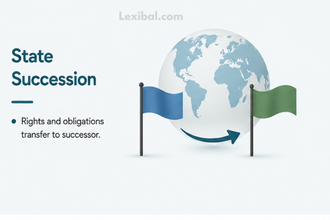
Territorial Disputes and State Succession
State succession can generate territorial disputes concerning the boundaries and territories of:
- newly independent States;
- successor States;
- continuing States.
International Law generally places strong emphasis on maintaining established boundaries following State succession.
Territorial Disputes and Self-Determination
Self-determination may become relevant where the disputed territory concerns a people whose political status is legally protected.
This is particularly significant in:
- colonial territories;
- territories under foreign domination;
- situations involving recognised self-determination claims.
Self-determination must be balanced with other applicable principles, including territorial integrity.
Territorial Disputes and Occupation
Military occupation does not automatically create sovereignty.
An occupying State may exercise effective control over territory without acquiring lawful territorial title.
Therefore:
Occupation → Effective control
but not necessarily:
Occupation → Sovereignty
Territorial Disputes and Annexation
Unilateral annexation following unlawful force does not automatically create lawful territorial title.
Modern International Law strongly rejects territorial acquisition through prohibited force.
Prohibition on Use of Force
A territorial dispute does not provide a general right to use force.
States must resolve territorial disputes through peaceful means.
The prohibition on the use of force protects:
- territorial integrity;
- political independence;
- sovereignty.
Peaceful Settlement of Territorial Disputes
International Law provides several peaceful methods for resolving territorial disputes.
These include:
- negotiation;
- mediation;
- good offices;
- conciliation;
- inquiry;
- arbitration;
- judicial settlement;
- regional mechanisms.
Negotiation
Negotiation allows the disputing States to directly discuss the territorial issue and seek a mutually acceptable settlement.
It may involve:
- exchange of maps;
- historical evidence;
- treaty interpretation;
- boundary surveys;
- compromise arrangements.
Mediation
A third State or other neutral party may assist the disputing States in reaching an agreement.
The mediator generally facilitates discussions rather than imposing a binding decision.
Conciliation
A conciliation body examines the dispute and proposes a settlement.
The recommendation may not necessarily be binding unless the parties have agreed otherwise.
Arbitration
States may submit their territorial dispute to an arbitral tribunal.
The tribunal may determine:
- sovereignty;
- boundary location;
- treaty interpretation;
- applicable principles of International Law.
The award is generally binding according to the terms of the arbitration agreement.
Judicial Settlement
States may submit territorial disputes to an international court, particularly the International Court of Justice where jurisdiction exists.
The Court may examine:
- treaties;
- historical title;
- maps;
- State conduct;
- effectivités;
- acquiescence;
- applicable customary rules.
International Court of Justice and Territorial Disputes
The ICJ has decided numerous territorial disputes.
Its decisions demonstrate that territorial sovereignty is generally determined through a careful examination of legal title and relevant State conduct rather than simply identifying which State currently exercises physical control.
Important Cases
Island of Palmas Arbitration, 1928
The Island of Palmas arbitration is a leading authority on territorial sovereignty.
The tribunal emphasised the importance of the continuous and peaceful display of State authority.
The case is particularly important for:
- territorial title;
- effectivités;
- discovery;
- sovereignty.
Eastern Greenland, 1933
The Legal Status of Eastern Greenland case involved competing territorial claims.
The Court examined:
- State intention;
- governmental acts;
- official statements;
- conduct concerning sovereignty.
Minquiers and Ecrehos, 1953
The dispute between the United Kingdom and France concerned sovereignty over the Minquiers and Ecrehos groups.
The Court placed significant emphasis on actual exercise of State authority.
Temple of Preah Vihear, 1962
The dispute between Cambodia and Thailand concerned sovereignty over the Temple of Preah Vihear.
The Court considered:
- maps;
- State conduct;
- acceptance;
- acquiescence.
The case demonstrates the importance of conduct surrounding territorial claims.
Frontier Dispute (Burkina Faso/Mali), 1986
The case is important for uti possidetis juris and the principle of stability of inherited boundaries.
The Court emphasised the importance of maintaining colonial administrative boundaries at independence.
Libya/Chad, 1994
The Territorial Dispute (Libya/Chad) case is important for the role of treaties in determining territorial title.
The Court placed significant importance on the applicable treaty framework in determining the boundary.
Cameroon v. Nigeria, 2002
The case involved territorial and maritime boundary disputes.
The Court examined treaty-based title and relevant geographical and legal evidence.
Territorial Disputes and Boundary Disputes
These terms are closely related but not identical.
Territorial Dispute
Broad disagreement concerning sovereignty or territorial title.
Boundary Dispute
More specifically concerns the location or interpretation of the boundary separating two States.
A boundary dispute may therefore be one type of territorial dispute.
Territorial Disputes and Maritime Disputes
Maritime territorial disputes involve overlapping claims to maritime areas.
They may concern:
- territorial seas;
- continental shelves;
- exclusive economic zones;
- islands and their maritime entitlements.
These disputes are governed significantly by the law of the sea.
Territorial Disputes and Natural Resources
Territorial sovereignty can determine control over valuable resources such as:
- oil;
- gas;
- minerals;
- fisheries;
- forests;
- freshwater.
Consequently, territorial disputes may have significant economic implications.
Territorial Disputes and Provisional Arrangements
While a dispute is pending, States may agree to temporary arrangements concerning:
- administration;
- resource exploitation;
- security;
- navigation;
- access.
Such arrangements do not necessarily determine the final question of sovereignty.
Good Faith
States involved in territorial disputes are expected to act in good faith.
This includes:
- respecting existing agreements;
- complying with provisional arrangements;
- avoiding actions that unnecessarily aggravate the dispute;
- pursuing peaceful settlement.
Non-Recognition
International Law may require States not to recognise territorial situations created through serious violations of fundamental international rules.
This is particularly important where territorial acquisition results from:
- unlawful force;
- illegal annexation;
- serious violations of fundamental international obligations.
Territorial Disputes and International Peace
Territorial disputes can threaten international peace and security.
Peaceful settlement mechanisms therefore serve two purposes:
- determining the legal rights of the parties; and
- preventing escalation into armed conflict.
Common Confusions
Is possession the same as sovereignty?
No. Physical control does not automatically establish lawful territorial title.
Does occupation transfer sovereignty?
No.
Does a historical claim automatically establish title?
No. Historical evidence must be assessed alongside treaties, State practice and applicable International Law.
Does a map establish sovereignty?
Not automatically. Its evidentiary value depends upon the circumstances.
Does silence always amount to acquiescence?
No.
Does uti possidetis juris apply to every territorial dispute?
No. It is particularly important in contexts involving decolonisation and State independence.
Can force be used to settle a territorial dispute?
No. A territorial claim does not create a general right to use prohibited force.
Can a referendum automatically settle sovereignty?
No. Its legal effect depends upon the applicable legal framework and circumstances.
Topic at a Glance
| Point | Position |
|---|---|
| Territorial dispute | Competing claims to sovereignty or territorial title |
| Main issue | Which State has the better legal title |
| Evidence | Treaties, maps, State conduct, effectivités, historical title |
| Effectivités | Actual exercise of governmental authority |
| Acquiescence | Acceptance inferred from State conduct |
| Estoppel | May prevent inconsistent territorial claims |
| Uti possidetis juris | Important in decolonisation |
| Occupation | Does not automatically transfer sovereignty |
| Force | Cannot lawfully establish territorial title |
| Settlement | Negotiation, mediation, arbitration, judicial settlement |
| Key cases | Island of Palmas, Eastern Greenland, Preah Vihear, Burkina Faso/Mali, Libya/Chad, Cameroon/Nigeria |
Quick Revision
- A territorial dispute is a disagreement concerning sovereignty or territorial title.
- The central question is generally which State possesses the stronger legal title.
- Territorial title may arise from:
- treaties;
- cession;
- historical title;
- effectivités;
- judicial or arbitral decisions.
- Effective control does not automatically equal lawful sovereignty.
- Effectivités are actual acts demonstrating State authority.
- Acquiescence may support another State’s territorial claim.
- Estoppel may prevent inconsistent territorial positions.
- Maps may provide evidence but do not automatically establish title.
- Uti possidetis juris is particularly important in decolonisation.
- Occupation does not automatically transfer sovereignty.
- Unlawful force cannot create lawful territorial title.
- Territorial disputes should be settled through peaceful means.
- Methods include:
- negotiation;
- mediation;
- conciliation;
- arbitration;
- judicial settlement.
- Important cases include:
- Island of Palmas;
- Eastern Greenland;
- Minquiers and Ecrehos;
- Temple of Preah Vihear;
- Burkina Faso/Mali;
- Libya/Chad;
- Cameroon/Nigeria.
- The essential principle is:
Territorial sovereignty is determined primarily through legal title and relevant State conduct, and territorial disputes must be resolved in accordance with International Law and peaceful settlement mechanisms.
Conclusion
Territorial disputes are disagreements concerning sovereignty, territorial title or the precise boundaries of States. Their resolution requires a careful examination of treaties, historical title, State practice, effectivités, maps, acquiescence and other relevant evidence. International Law does not treat mere physical possession as automatically establishing sovereignty, particularly where territory has been acquired through unlawful force or military occupation. Principles such as territorial integrity, uti possidetis juris, self-determination and the prohibition on the use of force may also become relevant depending upon the circumstances. States are expected to resolve territorial disputes through peaceful means, including negotiation, mediation, arbitration and judicial settlement. Decisions such as Island of Palmas, Eastern Greenland, Temple of Preah Vihear, Burkina Faso/Mali, Libya/Chad and Cameroon/Nigeria demonstrate the methods used by international tribunals and courts to determine territorial title. Ultimately, the law of territorial disputes seeks to establish territorial certainty while preventing disagreements over sovereignty from developing into unlawful uses of force.