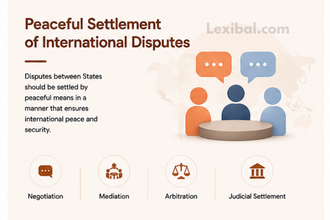





The principle of international cooperation is a fundamental principle of Public International Law that recognises the need for States to work together in addressing matters affecting the international community. Modern international relations involve problems that cannot be effectively addressed by States acting individually. Peace and security, human rights, economic development, public health, environmental protection and other transnational issues therefore require sustained international cooperation.
- Meaning of International Cooperation
- Legal Basis
- International Cooperation as a Fundamental Principle
- Main Objectives of International Cooperation
- Forms of International Cooperation
- International Cooperation and State Sovereignty
- International Cooperation and Good Faith
- International Cooperation and Non-Intervention
- International Cooperation and Self-Determination
- International Cooperation and Human Rights
- International Cooperation and Developing States
- Principle of Cooperation in the Friendly Relations Declaration
- Limitations of the Principle
- Important Distinctions
- Important International Instruments
- Important Cases
- Common Confusions
- Relationship with Related Principles
- Topic at a Glance
- Quick Revision
- Conclusion
The principle is reflected in the United Nations Charter and has been further developed through international treaties, customary international law, international organisations and State practice. It represents a movement from a purely State-centric conception of international law towards a system that also recognises common interests and collective responsibilities.
Meaning of International Cooperation
International cooperation means that States and other international actors work together in good faith to achieve common objectives and address matters of international concern.
Cooperation may take different forms, including:
- entering into international treaties;
- sharing information;
- coordinating policies;
- providing economic or technical assistance;
- cooperating through international organisations;
- jointly addressing international threats;
- participating in international dispute settlement;
- developing common international standards.
International cooperation does not eliminate State sovereignty. States cooperate while remaining sovereign members of the international community.
Legal Basis
United Nations Charter
International cooperation is one of the purposes of the United Nations.
Article 1(3) of the UN Charter identifies the achievement of international cooperation in solving international problems of an economic, social, cultural or humanitarian character and promoting and encouraging respect for human rights and fundamental freedoms as one of the purposes of the Organisation.
The Charter also establishes cooperation as an important element of the relationship among States.
Article 55 of the UN Charter
Article 55 provides for the promotion of conditions of:
- economic and social progress and development;
- solutions to international economic, social, health and related problems;
- international cultural and educational cooperation;
- universal respect for and observance of human rights and fundamental freedoms.
These objectives demonstrate the broad scope of international cooperation.
Article 56 of the UN Charter
Under Article 56, Members of the United Nations pledge themselves to take joint and separate action in cooperation with the Organisation for the achievement of the purposes set out in Article 55.
The provision therefore connects international cooperation with concrete commitments undertaken by UN Members.
International Cooperation as a Fundamental Principle
International cooperation has become increasingly important because States are interdependent.
A State’s actions can have consequences beyond its own territory.
For example:
- environmental pollution can cross borders;
- diseases can spread internationally;
- financial crises can affect multiple economies;
- armed conflicts can create regional instability;
- cyber activities can affect infrastructure in other States;
- climate change cannot be addressed by one State alone.
International cooperation provides a legal and institutional framework for responding to such problems.
Main Objectives of International Cooperation
1. Maintenance of International Peace and Security
Cooperation among States is essential for preventing and responding to threats to international peace and security.
The United Nations provides a central institutional framework for collective action.
Cooperation may involve:
- diplomatic negotiations;
- mediation;
- peacekeeping;
- collective security measures;
- arms-control arrangements;
- information sharing.
2. Economic Development
International cooperation promotes economic development through:
- trade arrangements;
- development assistance;
- financial cooperation;
- technical assistance;
- international development programmes.
International economic institutions provide mechanisms through which States coordinate their policies and pursue common objectives.
3. Protection of Human Rights
States cooperate through international human rights treaties and institutions to promote and protect fundamental rights.
International cooperation has contributed to the development of standards concerning:
- civil and political rights;
- economic, social and cultural rights;
- racial discrimination;
- discrimination against women;
- rights of children;
- prevention of torture;
- protection of refugees.
4. Environmental Protection
Environmental problems frequently transcend national borders.
International cooperation is therefore essential in areas such as:
- climate change;
- biodiversity;
- transboundary pollution;
- marine protection;
- conservation of natural resources;
- hazardous waste.
States have developed numerous international agreements to address these problems.
5. International Health
Public health threats can spread rapidly across borders.
International cooperation allows States to:
- exchange information;
- coordinate responses;
- develop common standards;
- provide assistance;
- address international health emergencies.
6. International Trade
International trade requires common rules and cooperation among States.
International economic agreements and institutions provide frameworks for:
- trade liberalisation;
- dispute settlement;
- customs cooperation;
- regulation of international commerce.
7. Combating International Crime
Transnational crimes cannot always be effectively addressed by one State.
International cooperation is therefore important in combating:
- terrorism;
- organised crime;
- human trafficking;
- drug trafficking;
- money laundering;
- cybercrime.
Cooperation may include extradition, mutual legal assistance, information sharing and joint investigations.
Forms of International Cooperation
Treaty-Based Cooperation
States may enter into treaties establishing specific rights and obligations.
Treaties can create long-term frameworks for cooperation in areas such as:
- trade;
- environment;
- human rights;
- security;
- criminal justice;
- health.
Institutional Cooperation
States cooperate through international organisations.
Examples include:
- United Nations;
- World Health Organization;
- World Trade Organization;
- International Labour Organization;
- International Maritime Organization;
- International Monetary Fund;
- World Bank.
Each organisation operates within the powers and limitations established by its constituent instrument.
Diplomatic Cooperation
Diplomatic relations provide a mechanism for States to communicate and coordinate their positions.
Cooperation may occur through:
- negotiations;
- diplomatic conferences;
- bilateral consultations;
- multilateral meetings;
- mediation.
Judicial Cooperation
States may cooperate through international courts and tribunals and through domestic judicial mechanisms.
Examples include cooperation concerning:
- recognition of judgments;
- extradition;
- evidence;
- arbitration;
- international criminal proceedings.
International Cooperation and State Sovereignty
International cooperation does not mean that States surrender their sovereignty merely by cooperating.
States remain sovereign and generally choose the international obligations they undertake, subject to applicable international law.
Cooperation may involve voluntarily accepting limitations through treaties or participating in international institutions.
Thus:
Sovereignty and international cooperation are not necessarily opposing principles. Sovereign States cooperate because many international objectives cannot be achieved effectively through unilateral action.
International Cooperation and Good Faith
Good faith is closely connected with international cooperation.
Cooperation requires States to:
- honour their international commitments;
- provide accurate information where required;
- participate meaningfully in agreed processes;
- avoid deliberately frustrating international arrangements;
- perform treaty obligations in good faith.
The principle of pacta sunt servanda is particularly important where cooperation is treaty-based.
International Cooperation and Non-Intervention
International cooperation must be distinguished from unlawful intervention.
Cooperation
Involves working with another State to achieve an agreed objective.
Intervention
Involves prohibited interference, particularly coercive interference, in matters within another State’s protected sphere.
A State does not violate non-intervention merely because it cooperates with another State.
However, cooperation cannot be used as a pretext for unlawful interference.
International Cooperation and Self-Determination
The UN Charter links international cooperation with the principle of equal rights and self-determination of peoples.
Cooperation should therefore operate consistently with the rights recognised under international law.
International cooperation may assist peoples and States in achieving political, economic, social and cultural development.
International Cooperation and Human Rights
Modern international law recognises that human rights protection is not exclusively a domestic matter.
States cooperate through:
- human rights treaties;
- international monitoring mechanisms;
- reporting systems;
- international institutions;
- regional human rights mechanisms.
At the same time, cooperation must respect the legal framework governing the relevant international institution or treaty.
International Cooperation and Developing States
International cooperation has particular importance for developing States.
International legal instruments and institutions promote cooperation concerning:
- economic development;
- technology transfer;
- capacity building;
- education;
- health;
- food security;
- sustainable development.
The principle is closely connected with the idea that international problems should be addressed through collective efforts rather than exclusively through unilateral action.
Principle of Cooperation in the Friendly Relations Declaration
The 1970 Declaration on Principles of International Law concerning Friendly Relations and Cooperation among States expressly recognises the duty of States to cooperate with one another.
It identifies cooperation in areas such as:
- maintenance of international peace and security;
- universal respect for human rights;
- economic, social, cultural and technical progress;
- international relations.
The Declaration places cooperation within the broader framework of sovereign equality, peaceful settlement, non-intervention and fulfilment of international obligations.
Limitations of the Principle
International cooperation does not mean that States have an unlimited legal duty to cooperate in every matter.
The extent of an obligation depends upon:
- applicable treaties;
- customary international law;
- UN Charter obligations;
- decisions of competent international institutions;
- other applicable rules of international law.
A general political desire for cooperation should not automatically be treated as a specific legally enforceable obligation.
Similarly, cooperation must not be confused with a requirement that States always adopt identical policies.
Important Distinctions
International Cooperation vs State Consent
| Point | International Cooperation | State Consent |
|---|---|---|
| Meaning | Joint action to pursue common objectives | Acceptance of a legal obligation or arrangement |
| Focus | Relationship and collective action | Legal acceptance |
| Example | States jointly addressing climate change | States becoming parties to a treaty |
| Relationship | Often depends upon agreed legal frameworks | May provide the basis for cooperation |
Cooperation vs Intervention
| Point | Cooperation | Intervention |
|---|---|---|
| Nature | Joint or coordinated action | External interference |
| Consent | Generally based on agreement or accepted legal framework | May be coercive and without lawful consent |
| Purpose | Common objective | May seek to influence another State’s protected affairs |
| Legal status | Generally lawful | Can violate international law |
International Cooperation vs Collective Security
| Point | International Cooperation | Collective Security |
|---|---|---|
| Scope | Broad and covers many fields | Primarily concerned with international peace and security |
| Areas | Economic, social, environmental, humanitarian and other matters | Threats to peace, breaches of peace and aggression |
| Framework | UN and other international institutions | Primarily UN Charter system |
| Nature | Broad principle | Specific institutional mechanism |
Important International Instruments
United Nations Charter
The UN Charter provides the central legal foundation for international cooperation.
Article 1(3) identifies international cooperation as one of the purposes of the United Nations, while Articles 55 and 56 provide a more specific framework for cooperation in economic, social, health, cultural and human rights matters.
Friendly Relations Declaration, 1970
The Declaration elaborates the duty of States to cooperate and connects it with the broader principles governing friendly relations among States.
Sustainable Development Goals
The UN Sustainable Development Goals provide an important contemporary framework for international cooperation in areas such as poverty, health, education, environment and sustainable development.
They are primarily a policy framework rather than a treaty creating universally binding obligations in themselves.
Important Cases
Corfu Channel Case, 1949
The International Court of Justice examined the obligations of States in relation to activities affecting other States.
The judgment is relevant to the broader principle that States must take account of the rights and interests of other members of the international community.
Barcelona Traction, Light and Power Company, Limited, 1970
The ICJ distinguished between obligations owed to particular States and obligations owed to the international community as a whole.
The case is relevant to the development of international law based on common international interests.
Gabčíkovo-Nagymaros Project, 1997
The ICJ considered treaty obligations, environmental concerns and the need for cooperation between States concerning a shared development project.
The case demonstrates how cooperation can become particularly important where States share resources or face transboundary consequences.

Common Confusions
Does international cooperation mean that States lose their sovereignty?
No.
States can cooperate while retaining their sovereign status. They may voluntarily undertake international obligations while remaining sovereign members of the international community.
Is every failure to cooperate a violation of international law?
No.
A general principle of cooperation does not mean that every refusal to cooperate automatically creates international responsibility. A specific legal obligation must exist where a breach is alleged.
Is international cooperation legally binding in every situation?
No.
The legal character of a particular obligation depends upon its source and content. Some cooperation duties arise from treaties or customary law, while other forms of cooperation may be political or voluntary.
Is cooperation the same as intervention?
No.
Lawful cooperation generally involves coordination or assistance consistent with international law. Intervention concerns prohibited interference, particularly coercive interference, in another State’s affairs.
Does international cooperation require States to follow the same policies?
No.
States may cooperate while maintaining different political, economic and legal systems.
Is the UN Sustainable Development Goals framework itself a treaty?
No.
The Sustainable Development Goals provide a global policy framework and do not themselves operate as a treaty imposing universally binding obligations.
Relationship with Related Principles
Sovereign Equality
International cooperation takes place between States that remain legally equal and sovereign.
Good Faith
Cooperation requires States to perform applicable international obligations honestly and in good faith.
Peaceful Settlement
Cooperation can facilitate peaceful resolution of disputes through negotiation, mediation and other peaceful methods.
Self-Determination
International cooperation must operate consistently with the principle of equal rights and self-determination of peoples.
Non-Intervention
Cooperation must not become a means of unlawful coercive interference in another State’s affairs.
International Peace and Security
Cooperation is a central mechanism through which States pursue international peace and security.
Topic at a Glance
| Point | Position |
|---|---|
| Principle | International Cooperation |
| Main legal basis | UN Charter |
| Key provisions | Articles 1(3), 55 and 56 |
| Central idea | States should work together to address common international concerns |
| Major areas | Peace, human rights, development, health, environment, trade and crime prevention |
| Institutional framework | United Nations and specialised international organisations |
| Important declaration | Friendly Relations Declaration, 1970 |
| Key limitation | Not every general expectation of cooperation creates a legally enforceable obligation |
| Related principles | Sovereign equality, good faith, self-determination and peaceful settlement |
| Important case | Gabčíkovo-Nagymaros Project |
Quick Revision
- International cooperation is a fundamental principle of modern Public International Law.
- It recognises the need for States to work together to address matters of common international concern.
- Article 1(3) of the UN Charter identifies international cooperation as one of the purposes of the United Nations.
- Article 55 addresses cooperation concerning economic, social, health, cultural and human rights matters.
- Article 56 requires UN Members to take joint and separate action in cooperation with the Organisation to achieve the purposes of Article 55.
- Cooperation occurs through:
- treaties;
- international organisations;
- diplomacy;
- judicial mechanisms;
- technical and economic assistance.
- Major areas include peace and security, human rights, environment, health, trade and international crime.
- International cooperation does not abolish State sovereignty.
- Cooperation must be distinguished from unlawful intervention.
- Good faith is essential to effective international cooperation.
- Not every failure to cooperate automatically constitutes a breach of international law.
- The Friendly Relations Declaration, 1970 provides an important formulation of the duty of cooperation.
- The Gabčíkovo-Nagymaros Project case illustrates the importance of cooperation in shared and transboundary matters.
- International cooperation reflects the increasing interdependence of States.
- The modern international legal system increasingly requires collective responses to problems that cannot be effectively addressed by individual States.
Conclusion
The principle of international cooperation reflects the reality that States are increasingly interconnected and that many international problems cannot be effectively addressed through unilateral action. The UN Charter places cooperation at the centre of the international system, particularly in relation to peace, human rights, economic and social development and other matters of international concern. At the same time, cooperation operates within the framework of sovereignty and international law and does not automatically create a specific legal obligation in every situation. Its importance lies in providing a foundation for collective action while preserving the sovereign equality and independence of States.