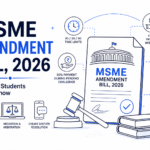












Parliament has passed the Micro, Small and Medium Enterprises Development (Amendment) Bill, 2026, introducing changes aimed at improving payment recovery for MSMEs, speeding up dispute resolution and simplifying certain regulatory requirements.
The Bill was passed by the Rajya Sabha on August 3 and by the Lok Sabha on August 7. It will now require the President’s assent before coming into force.
The legislation proposes several amendments to the Micro, Small and Medium Enterprises Development Act, 2006, with a particular focus on delayed payments owed to micro and small enterprises.
Time-Bound Resolution of Delayed Payment Disputes
The Bill introduces specific timelines for resolving disputes relating to delayed payments.
Under the proposed framework, mediation conducted through the Micro and Small Enterprises Facilitation Council (MSEFC) or a mediation service provider would have to be completed within 90 days from the date fixed for the first appearance.
If mediation does not resolve the dispute, the matter would have to be referred for arbitration within 30 days from the termination of mediation.
The MSEFC or the relevant alternative dispute resolution institution would then be required to make an arbitral award within 90 days from the completion of pleadings.
The amendments also provide for Online Dispute Resolution (ODR) mechanisms to facilitate faster and more cost-effective resolution of disputes.
50% of Award Amount in Certain Pending Challenges
The Bill seeks to strengthen the position of micro and small enterprises when an award, decree or order is challenged.
Where an application to set aside a decree, award or order remains pending for more than six months, the proposed framework provides for payment of at least 50% of the awarded amount to the micro or small enterprise supplier, subject to the applicable provisions.
The provision is aimed at preventing prolonged proceedings from completely delaying recovery of amounts awarded to MSMEs.
Recovery of Dues as Arrears of Land Revenue
The amendments also introduce a stronger recovery mechanism for amounts payable under mediated settlements and arbitral awards.
A mediated settlement agreement or arbitral award made through the Facilitation Council, mediation service provider or an alternative dispute resolution institution under Section 18 may be recovered as an arrear of land revenue.
Such recovery may be undertaken through the District Collector, Deputy Commissioner or another notified authority having jurisdiction over the buyer’s assets.
Also Read: Remote Legal Internship at Kridey Foundation Trust
TReDS to Facilitate Faster Payments
The Bill also seeks to strengthen the use of the Trade Receivables Discounting System (TReDS) for settling invoices involving MSMEs.
Central Public Sector Enterprises (CPSEs) would be required to route settlement of invoices for goods and services procured from MSMEs through a TReDS platform.
The amendments also provide an enabling mechanism for States to encourage their public sector enterprises to use TReDS for invoice settlement.
The move is intended to improve cash flow for MSMEs and reduce the impact of delayed payments on their operations.
Changes to MSME Registration and Classification
The Bill seeks to align the MSME framework with changes in the business environment by incorporating investment in plant and machinery and turnover as the basis for classification.
It also provides permanence to the Udyam Registration Portal as a digital platform for MSME registration.
Registration through the portal will remain voluntary and free.
Certain Offences to Be Decriminalised
The amendments also propose the decriminalisation of certain violations under the MSME framework.
Conviction-based penalties would be replaced in specified cases with a graded civil penalty system.
For furnishing incorrect information, a warning would be issued for the first instance, followed by a penalty for subsequent instances.
Similarly, provisions relating to non-disclosure of unpaid amounts along with interest in annual accounts by buyers would follow a graded system involving a warning for the first instance, a penalty for the second and a fine for subsequent instances.
Bill Awaits Presidential Assent
The MSME Development (Amendment) Bill, 2026, seeks to address delayed payments while introducing changes intended to make dispute resolution and regulatory compliance more efficient.
With provisions covering time-bound mediation and arbitration, Online Dispute Resolution, recovery of awards, TReDS-based invoice settlement and decriminalisation of specified violations, the Bill proposes significant changes to the existing MSME framework.
The legislation has cleared both Houses of Parliament and will become law after receiving the President’s assent and coming into force in accordance with the notified commencement provisions.