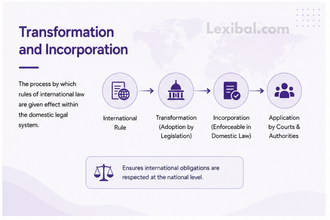











International Law and Municipal Law are closely connected in India, particularly in relation to treaties, customary international law and the interpretation of domestic legislation. India is generally described as following a predominantly dualist approach, especially with respect to treaties. This means that an international treaty accepted by India does not automatically become enforceable as domestic law merely because India has undertaken an international obligation. Where domestic implementation is required, appropriate legislation may be necessary. At the same time, Indian courts have recognised the importance of international law and have used international norms as interpretative aids where they are consistent with the Constitution and domestic law.
- Meaning of International Law
- Meaning of Municipal Law
- Relationship Between International Law and Municipal Law
- Constitutional Framework in India
- Article 51(c)
- Article 253
- Article 73
- Seventh Schedule
- Treaties and Municipal Law in India
- Role of Parliament
- Treaty-Making Power and Domestic Implementation
- Customary International Law in India
- International Law as an Interpretative Aid
- Conditions for Using International Law
- Harmonious Interpretation
- International Law and Fundamental Rights
- Important Indian Cases
- International Law and Human Rights
- International Law and Environmental Law
- Conflict Between International Law and Municipal Law
- International Law and Constitutional Supremacy
- International Law and Judicial Review
- Transformation and Incorporation in India
- International Law and Municipal Law: Key Comparison
- Important Constitutional Provisions
- Common Confusions
- Topic at a Glance
- Quick Revision
- Conclusion
Meaning of International Law
International Law is the body of legal rules governing relations among States and other recognised participants in the international legal system.
It deals with matters such as:
- treaties;
- customary international law;
- international organisations;
- State responsibility;
- human rights;
- international peace and security;
- diplomatic relations;
- law of the sea;
- international humanitarian law.
Meaning of Municipal Law
Municipal Law, also called domestic law, refers to the law operating within a particular State.
In India, municipal law includes:
- the Constitution of India;
- Parliamentary legislation;
- State legislation;
- delegated legislation;
- judicial decisions;
- recognised principles of domestic law.
Municipal law primarily regulates relationships within the Indian legal system and provides the rules directly applied by Indian courts.
Relationship Between International Law and Municipal Law
The relationship between International Law and Municipal Law is traditionally explained through two theories:
Monism
Monism considers international and domestic law to be parts of a single legal system.
Under a monist approach, international rules may operate directly within the domestic legal system, depending upon the constitutional structure of the State.
Dualism
Dualism considers international and domestic law to be separate legal systems.
Under a dualist approach, an international obligation does not automatically become enforceable domestic law. Domestic legislation may be required to give the international obligation effect within the municipal legal system.
Indian Position
India is generally regarded as predominantly dualist, particularly in relation to treaty implementation.
However, the Indian position is not absolute. Indian courts frequently refer to international law when interpreting constitutional provisions and domestic legislation, provided there is no conflict with domestic law.
Constitutional Framework in India
The Indian Constitution contains several provisions relevant to international law.
The most important provisions include:
- Article 51;
- Article 73;
- Article 253;
- relevant provisions of the Seventh Schedule.
Article 51(c)
Article 51 forms part of the Directive Principles of State Policy.
Article 51(c) provides that the State shall endeavour to:
“foster respect for international law and treaty obligations in the dealings of organised peoples with one another.”
This provision reflects the constitutional importance given to international law and treaty obligations.
However, Article 51 is contained in Part IV of the Constitution and is not directly enforceable by courts in the same manner as Fundamental Rights.
It nevertheless has significant interpretative value.
Article 253
Article 253 is one of the most important constitutional provisions concerning the domestic implementation of international agreements.
It empowers Parliament to make laws for implementing:
- treaties;
- agreements;
- conventions;
- decisions made at international conferences, associations or other bodies.
The power under Article 253 operates notwithstanding the ordinary distribution of legislative powers between the Union and the States.
Thus, Parliament can enact legislation necessary to implement India’s international commitments.
Article 73
Article 73 concerns the extent of the executive power of the Union.
The executive power of the Union extends to matters with respect to which Parliament has power to make laws and to the exercise of rights, authority and jurisdiction that are exercisable by the Government of India by virtue of a treaty or agreement.
However, the existence of executive power to enter into or perform international agreements does not necessarily mean that an agreement automatically becomes enforceable as domestic law.
Where domestic legislation is necessary, Parliament may legislate under Article 253.
Seventh Schedule
The Seventh Schedule distributes legislative powers between the Union and the States.
International relations and several matters connected with international law fall within the Union’s legislative sphere.
This constitutional arrangement enables Parliament to enact legislation dealing with India’s international obligations.
Treaties and Municipal Law in India
India generally distinguishes between the international validity of a treaty and its domestic enforceability.
International Level
India may become internationally bound by a treaty according to the applicable rules of international law.
Domestic Level
The treaty may require domestic legislation before its provisions can be enforced by Indian courts.
Therefore:
International obligation does not automatically mean domestic enforceability.
This distinction reflects India’s predominantly dualist approach.
Role of Parliament
Parliament plays an important role when an international agreement requires domestic implementation.
The basic process can be understood as:
International Agreement
↓
International obligation of India
↓
Domestic legislation, where required
↓
Domestic legal effect
Article 253 provides the constitutional basis for Parliament to enact such legislation.
Treaty-Making Power and Domestic Implementation
The executive has an important role in India’s international relations and treaty-making.
However, an international agreement cannot, merely by executive acceptance, alter existing domestic law or create domestic legal rights and obligations contrary to the existing legal framework where legislative action is constitutionally required.
Thus, two questions must be separated:
- Is India internationally bound?
- Can the agreement be directly enforced in an Indian court?
The answer to these questions may not be the same.
Customary International Law in India
Customary international law has a somewhat different position from treaties.
Indian courts may recognise and apply principles of customary international law where they are consistent with:
- the Constitution;
- legislation;
- established principles of Indian law.
Customary international law can therefore influence judicial reasoning without necessarily requiring the same legislative process applicable to treaty obligations.
However, where a clear domestic statutory provision conflicts with an international customary rule, the domestic court generally applies the domestic legislation within the municipal legal system.
International Law as an Interpretative Aid
One of the most important features of Indian judicial practice is the use of international law as an interpretative aid.
Indian courts may consider:
- international conventions;
- international covenants;
- customary international law;
- international declarations;
- international standards.
This is particularly significant where domestic legislation or constitutional provisions are ambiguous or incomplete.
Conditions for Using International Law
International law may be used by Indian courts particularly where:
- domestic legislation is ambiguous;
- there is a legislative gap;
- the international norm is relevant to the issue;
- there is no inconsistency with domestic law;
- the international principle assists constitutional interpretation.
However, international law cannot ordinarily be used to override clear domestic legislation.
Harmonious Interpretation
Indian courts may attempt to interpret domestic law consistently with India’s international obligations where the language of domestic law permits such an interpretation.
This approach is sometimes described as harmonious interpretation.
The objective is to avoid unnecessary conflict between India’s domestic legal system and its international commitments.
However:
International law cannot normally override clear and unambiguous domestic legislation merely because an international obligation exists.
International Law and Fundamental Rights
International human rights law has significantly influenced the interpretation of Fundamental Rights in India.
Where international norms are consistent with constitutional guarantees, Indian courts may use them to:
- clarify the meaning of rights;
- strengthen rights-based interpretation;
- address legislative gaps;
- develop constitutional protections.
This has been particularly important in areas such as:
- equality;
- dignity;
- gender justice;
- personal liberty;
- protection against discrimination.
Important Indian Cases
Maganbhai Ishwarbhai Patel v. Union of India, 1969
The Supreme Court considered the relationship between international agreements and domestic law.
The case is important for understanding the constitutional position concerning treaty implementation in India.
It illustrates the distinction between India’s international obligations and the domestic implementation of those obligations.
Jolly George Varghese v. Bank of Cochin, 1980
This is an important case concerning the domestic effect of an international covenant.
The Supreme Court considered the International Covenant on Civil and Political Rights in relation to Indian domestic law.
The Court recognised the importance of India’s international commitments but emphasised that an international covenant does not automatically become enforceable domestic law merely because India has accepted it.
The case is therefore an important authority for India’s predominantly dualist approach.
Gramophone Company of India Ltd. v. Birendra Bahadur Pandey, 1984
The Supreme Court considered the relationship between international law and domestic law.
The Court recognised the relevance of international law where it is consistent with domestic law.
However, where a clear domestic legal rule conflicts with an international rule, the domestic legal rule governs the domestic court’s decision.
Vishaka v. State of Rajasthan, 1997
The Supreme Court relied upon international conventions and norms concerning women’s rights while developing guidelines concerning sexual harassment at the workplace.
The case is a leading example of the use of international law as an interpretative aid where domestic legislation was inadequate.
The Court relied upon international norms while ensuring that they were consistent with constitutional guarantees.
International Law and Human Rights
International human rights instruments have had substantial influence on Indian constitutional jurisprudence.
Courts have considered instruments including:
- Universal Declaration of Human Rights;
- International Covenant on Civil and Political Rights;
- Convention on the Elimination of All Forms of Discrimination Against Women;
- Convention on the Rights of the Child.
These instruments may assist courts in interpreting constitutional and statutory provisions.
However, their international status does not automatically make every provision directly enforceable as Indian domestic law.
International Law and Environmental Law
International environmental principles have also influenced Indian courts.
Courts have considered principles such as:
- sustainable development;
- precautionary principle;
- polluter pays principle.
International environmental law may therefore contribute to domestic judicial reasoning where it is consistent with Indian law.
Conflict Between International Law and Municipal Law
The question of conflict is particularly important.
No Conflict
Where international law and domestic law are consistent, courts may apply or refer to international law where appropriate.
Ambiguous Domestic Law
International law may assist in interpreting the domestic provision.
Clear Domestic Law
Where a clear domestic law conflicts with an international rule, Indian courts generally apply the domestic law within the municipal legal system.
International Consequences
The domestic application of a conflicting law does not necessarily remove India’s responsibility under international law.
Therefore:
Domestic validity and international responsibility are separate questions.
International Law and Constitutional Supremacy
The Constitution is the supreme law within India’s domestic legal system.
International law cannot ordinarily override the Constitution merely because India has accepted an international obligation.
At the same time, international law may assist constitutional interpretation where the constitutional language permits such an approach.
International Law and Judicial Review
Where Parliament enacts legislation to implement a treaty, that legislation remains subject to constitutional limitations.
Therefore:
Treaty
↓
Implementing legislation
↓
Judicial review under the Constitution
The international origin of the legislation does not place it beyond constitutional scrutiny.

Transformation and Incorporation in India
India’s approach can largely be understood through the concept of transformation in relation to treaties.
Transformation
An international obligation is implemented through domestic legislation.
Incorporation
An international rule becomes part of domestic law through an established constitutional mechanism without requiring the creation of a separate domestic rule in the same manner.
India does not follow an absolutely rigid model.
The domestic effect of an international rule depends upon:
- the nature of the rule;
- constitutional provisions;
- existing legislation;
- treaty language;
- judicial interpretation.
International Law and Municipal Law: Key Comparison
| Point | International Law | Municipal Law in India |
|---|---|---|
| Main sphere | International relations | Domestic legal system |
| Main subjects | States, international organisations and other recognised participants | Individuals, institutions and domestic authorities |
| Sources | Treaties, custom, general principles and other recognised sources | Constitution, legislation, rules, judicial decisions etc. |
| Treaty effect | Creates international obligations | May require domestic implementation |
| Courts | International courts and tribunals | Indian courts |
| Conflict | May result in international responsibility | Domestic law generally governs domestic adjudication |
| Indian approach | International obligations recognised | Predominantly dualist regarding treaties |
Important Constitutional Provisions
| Provision | Relevance |
|---|---|
| Article 51(c) | Promotes respect for international law and treaty obligations |
| Article 73 | Deals with the extent of Union executive power |
| Article 253 | Enables Parliament to implement international agreements through legislation |
| Seventh Schedule | Allocates legislative powers, including matters concerning international relations |
| Article 141 | Supreme Court decisions are binding on all courts in India |
Common Confusions
Does signing or ratifying a treaty automatically make it Indian law?
No.
International acceptance of a treaty and domestic enforceability are distinct questions.
Can Parliament enact legislation to implement a treaty?
Yes.
Article 253 expressly provides Parliament with power to make laws for implementing treaties, agreements and conventions.
Can Indian courts use international law?
Yes.
International law may be used as an interpretative aid where it is relevant and consistent with domestic law.
Can international law override a clear Indian statute?
Generally, no.
A clear domestic legal provision ordinarily governs the domestic court’s decision.
Does this mean India can ignore its international obligations?
No.
India may remain internationally responsible for violating an international obligation even if domestic law permits the conduct.
Is India completely dualist?
No.
India is generally described as predominantly dualist, particularly in relation to treaties, but Indian courts have developed significant interaction between international and domestic law.
Can international conventions help interpret Fundamental Rights?
Yes.
Where relevant and consistent with domestic law, international conventions and norms may assist constitutional interpretation.
Is Article 51 directly enforceable?
No.
Article 51 forms part of the Directive Principles of State Policy and is not independently enforceable like a Fundamental Right.
Topic at a Glance
| Point | Position |
|---|---|
| Subject | International Law and Municipal Law in India |
| General approach | Predominantly dualist |
| Treaty implementation | Domestic legislation may be required |
| Article 51(c) | Respect for international law and treaty obligations |
| Article 253 | Parliament’s power to implement international agreements |
| Customary international law | May be recognised where consistent with domestic law |
| International treaties | May serve as interpretative aids |
| Clear domestic legislation | Generally prevails domestically |
| Constitutional supremacy | Constitution remains supreme domestically |
| Key cases | Maganbhai, Jolly George Varghese, Gramophone Company, Vishaka |
| Key distinction | International obligation vs domestic enforceability |
Quick Revision
- India follows a predominantly dualist approach, particularly regarding treaties.
- International Law and Municipal Law are treated as distinct legal systems.
- An international treaty does not automatically become enforceable domestic law merely because India accepts it internationally.
- Article 51(c) directs the State to foster respect for international law and treaty obligations.
- Article 253 empowers Parliament to enact legislation implementing treaties, agreements and conventions.
- The Union executive may enter into international agreements within its constitutional authority.
- Domestic legislation may be required where an international obligation needs domestic legal implementation.
- Indian courts may use international law as an interpretative aid.
- International norms can assist constitutional interpretation where there is no conflict with domestic law.
- Clear domestic legislation generally prevails in domestic adjudication over an inconsistent international rule.
- Domestic law does not necessarily excuse India from its international responsibility.
- Maganbhai Ishwarbhai Patel v. Union of India is important for treaty implementation.
- Jolly George Varghese v. Bank of Cochin is important for the domestic effect of international covenants.
- Gramophone Company v. Birendra Bahadur Pandey is important for the use of international law consistent with domestic law.
- Vishaka v. State of Rajasthan demonstrates the use of international norms as an interpretative aid.
- International human rights and environmental principles have influenced Indian judicial reasoning.
- The Indian position cannot be described as completely rigid because courts actively engage with international law.
- The central distinction is:
International obligation ≠ automatic domestic enforceability
Conclusion
The relationship between International Law and Municipal Law in India reflects a predominantly dualist approach combined with significant judicial engagement with international legal norms. Treaties accepted by India do not automatically become enforceable domestic law; where implementation requires domestic legislation, Parliament may legislate under Article 253. Article 51(c) reflects India’s constitutional commitment to respect international law and treaty obligations. At the same time, Indian courts may use international conventions, customary international law and international principles as interpretative aids where they are consistent with the Constitution and domestic legislation. Cases such as Jolly George Varghese, Gramophone Company and Vishaka demonstrate this approach. The essential distinction is between India’s international obligation and the domestic enforceability of that obligation.