




Order V of the Code of Civil Procedure, 1908 deals with the issue and service of summons upon the defendant after a suit has been instituted. The purpose of summons is to formally inform the defendant that a suit has been filed against them and to require them to appear before the court and answer the claim.
- Order V at a Glance
- Meaning of Summons
- Object of Order V
- Section 27 and Order V
- Order V Rule 1 – Summons
- Summons to Accompany the Plaint
- Contents of Summons
- Service of Summons
- Order V Rule 9 – Delivery or Transmission of Summons
- Personal Service
- Service on Agent
- Service on Family Member
- Refusal to Accept Summons
- Order V Rule 17 – Procedure When Defendant Refuses or Cannot Be Found
- Affixation of Summons
- Order V Rule 19 – Examination of Serving Officer
- Substituted Service – Order V Rule 20
- Purpose of Substituted Service
- Service Outside the Jurisdiction
- Service on Government or Public Officers
- Service on Corporation or Company
- Importance of Valid Service
- Ex Parte Proceedings and Service
- Natural Justice
- Important Case Law
- Common Confusions
- Practical Importance in Civil Litigation
- Importance for Law Students and Judiciary Exams
- Important Questions to Prepare
- Key Legal Principles
- Key Takeaways
Order V is therefore an important part of the principle of natural justice, because a person should ordinarily be given notice and an opportunity to defend before the court decides the dispute against them.
Order V at a Glance
| Particular | Details |
|---|---|
| Provision | Order V CPC |
| Subject | Issue and service of summons |
| Main purpose | Inform defendant about the suit and require appearance |
| Issued by | Court |
| Served upon | Defendant |
| Main requirements | Proper issue and valid service |
| Important provisions | Rules 1, 2, 9, 9A, 12, 15, 17, 19, 20 |
| Related provisions | Sections 27 and 28 CPC |
Meaning of Summons
A summons is a formal order issued by the court requiring a defendant to appear before the court in connection with a civil suit.
It serves two basic purposes:
- informing the defendant about the institution of the suit; and
- requiring the defendant to appear and answer the plaintiff’s claim.
The defendant must therefore be given sufficient information about the proceedings so that an effective defence can be prepared.
Object of Order V
The main objectives of Order V are:
- to provide notice of the suit to the defendant;
- to give the defendant an opportunity to appear and defend;
- to prescribe the manner in which summons should be served;
- to prevent defendants from avoiding proceedings through improper service;
- to provide alternative methods where ordinary service is unsuccessful; and
- to ensure that the court does not proceed against a defendant without proper procedural notice, except where the law permits otherwise.
Section 27 and Order V
Section 27 of the CPC provides the general statutory basis for issuing summons to a defendant after institution of a suit.
Order V supplies the detailed procedure concerning:
- issue of summons;
- contents of summons;
- service;
- modes of service;
- substituted service; and
- consequences of failure or refusal to accept service.
Therefore:
Section 27 → general statutory requirement of summons.
Order V → detailed procedure for issue and service of summons.
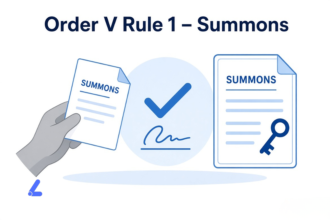
Order V Rule 1 – Summons
Order V Rule 1 deals with the issue of summons to the defendant.
After a suit has been duly instituted, summons may be issued to the defendant requiring the defendant to appear and answer the claim on a specified date.
The rule also deals with the requirement that the defendant should file the written statement within the period prescribed by the CPC and applicable rules.
The summons therefore marks the formal beginning of the defendant’s participation in the suit.
Summons to Accompany the Plaint
The summons is generally accompanied by a copy of the plaint.
This is important because the defendant must know:
- what the plaintiff is claiming;
- the facts relied upon;
- the relief sought; and
- the basis on which the plaintiff approaches the court.
A defendant cannot reasonably be expected to prepare a defence without knowing the substance of the plaintiff’s case.
Contents of Summons
A summons should contain sufficient information to enable the defendant to understand the proceeding.
Depending upon the applicable provisions and circumstances, it may specify:
- the court in which the suit is pending;
- the names of the parties;
- the nature of the proceeding;
- the date fixed for appearance;
- the requirement to answer the claim; and
- other information prescribed by the procedural rules.
The summons must be accompanied by the necessary documents required by the CPC.
Service of Summons
Issue and service of summons are different concepts.
Issue
The court formally prepares and issues the summons.
Service
The summons is delivered or communicated to the defendant in the manner prescribed by law.
Thus:
Issue = court sends out the summons.
Service = defendant is legally notified through the prescribed procedure.
A properly issued summons does not automatically mean that it has been validly served.
Order V Rule 9 – Delivery or Transmission of Summons
Order V Rule 9 deals with the manner in which summons may be delivered or transmitted for service.
The court may arrange for service through the prescribed process, including transmission through the appropriate court machinery or other legally recognised modes.
Modern procedural practice also permits electronic methods of service where authorised by applicable rules and directions.
The precise mode can depend upon the circumstances of the case and the applicable court rules.
Personal Service
The ordinary principle is that summons should be served upon the defendant personally where practicable.
Personal service ensures that the defendant directly receives knowledge of the proceeding.
However, the CPC recognises situations where personal service may not be possible.
In such cases, alternative methods prescribed by Order V may be used.
Service on Agent
Where the defendant has an authorised agent, service may in appropriate circumstances be made upon that agent.
The authority of the agent and the applicable procedural requirements are important.
This should not be confused with merely delivering a summons to any person associated with the defendant.
Service on Family Member
Order V also contains provisions dealing with circumstances in which the defendant cannot be found at the place where the defendant ordinarily resides or carries on business.
Under the applicable conditions, service may be made upon an adult member of the defendant’s family residing with the defendant.
The provision is subject to its statutory requirements and does not mean that summons can automatically be given to any relative.
Refusal to Accept Summons
A defendant may attempt to avoid service by refusing to accept the summons.
The CPC contains provisions dealing with refusal and the procedure to be followed by the serving officer.
The defendant cannot ordinarily defeat the proceedings simply by deliberately refusing to receive the document.
The serving officer records the relevant circumstances, and the court determines the legal effect of the attempted service.
Order V Rule 17 – Procedure When Defendant Refuses or Cannot Be Found
Order V Rule 17 deals with situations where the defendant or an authorised person refuses to sign the acknowledgement or where the serving officer cannot find the defendant and there is no appropriate person upon whom service can be made.
The serving officer follows the prescribed procedure, including affixing a copy of the summons in the manner required by the rule.
The serving officer must also make the required report concerning the circumstances of service.
Affixation of Summons
Affixing a copy of the summons is not simply an informal alternative to personal service.
It is a statutory procedure that becomes relevant in the circumstances specified by Order V.
The serving officer must comply with the prescribed requirements.
The court may subsequently examine whether the requirements for valid service through affixation were actually satisfied.
Order V Rule 19 – Examination of Serving Officer
Order V Rule 19 provides for the court’s consideration of the serving officer’s report where summons has been returned under the relevant provisions.
The court may examine the serving officer on oath or conduct such inquiry as it considers necessary.
The purpose is to determine whether service has been properly effected.
This provision is particularly important where the defendant disputes service.
Substituted Service – Order V Rule 20
Where the court is satisfied that the defendant is deliberately avoiding service or that summons cannot be served in the ordinary way, the court may order substituted service.
Substituted service is an exceptional method and should not be treated as the ordinary first step.
It may include:
- affixing the summons in a conspicuous place; or
- publication in a newspaper, where the court considers it appropriate.
The court must be satisfied that the statutory conditions for substituted service exist.
Purpose of Substituted Service
Substituted service prevents a defendant from defeating civil proceedings simply by deliberately avoiding ordinary service.
However, because substituted service can have serious consequences, courts generally require compliance with the procedural safeguards before treating it as valid.
The court should have sufficient material to conclude that ordinary service cannot reasonably be effected or that the defendant is avoiding service.
Service Outside the Jurisdiction
Order V also contains provisions dealing with service where the defendant resides outside the local jurisdiction of the court.
The method may depend upon:
- where the defendant resides;
- whether the defendant is within India or outside India;
- applicable agreements or arrangements;
- the applicable procedural rules; and
- the nature of the defendant.
The CPC therefore provides a framework for service even when the defendant is not within the ordinary territorial jurisdiction of the court.
Service on Government or Public Officers
Special rules apply in cases involving government or public officers.
The summons must be served in the manner prescribed by the CPC and applicable rules.
This is important because service upon the appropriate government authority or officer may be necessary before the proceedings can properly continue.
Service on Corporation or Company
Where the defendant is a corporation or company, service is generally made upon the appropriate officer or authorised person in accordance with the applicable rules.
The object remains the same: ensuring that the legal entity receives proper notice of the proceedings.
Importance of Valid Service
Valid service is fundamental because it gives the defendant an opportunity to participate in the proceedings.
If a defendant has not been properly served, proceeding against the defendant without following the applicable procedural safeguards may cause serious prejudice.
The importance of service becomes particularly clear when the plaintiff seeks an ex parte decree.
Ex Parte Proceedings and Service
Where a defendant does not appear despite proper service of summons, the court may proceed ex parte in accordance with the CPC.
However, the court must first be satisfied that the defendant was properly served or that service is legally deemed sufficient.
A mere allegation that the defendant knew about the case is not always a substitute for compliance with the prescribed requirements of service.
Natural Justice
The rules concerning summons reflect the basic principle of audi alteram partem, meaning that a person should be given an opportunity to be heard.
A defendant should ordinarily have:
- notice of the proceedings;
- knowledge of the claim;
- sufficient opportunity to appear; and
- an opportunity to present a defence.
Therefore, service of summons is not merely a technical formality.
Important Case Law
Neerja Realtors Pvt. Ltd. v. Janglu, (2018) 2 SCC 649
The Supreme Court emphasised the importance of proper compliance with the requirements governing substituted service.
The Court explained that substituted service should not be ordered mechanically and that the court must be satisfied that the statutory conditions for such service are fulfilled.
The case is particularly relevant to Order V Rule 20.
Sushil Kumar Sabharwal v. Gurpreet Singh, (2002) 5 SCC 377
The Supreme Court considered the significance of proper service in the context of ex parte proceedings.
The decision reinforces the principle that a defendant should not ordinarily be proceeded against without proper notice of the proceedings.
Common Confusions
Is issue of summons the same as service?
No.
Issue is the formal issuance of the summons by the court. Service is the process by which the summons is legally communicated to the defendant.
Is personal service the only method?
No.
The CPC recognises several modes of service, including service through authorised persons and substituted service in appropriate cases.
Can a defendant avoid service by refusing to accept the summons?
No.
The CPC provides procedures for dealing with refusal to accept service.
Can substituted service be ordered immediately?
It should not ordinarily be treated as the first method of service. The court must be satisfied that the conditions under Order V Rule 20 exist.
Why is service important before an ex parte proceeding?
Because the defendant should ordinarily have notice and an opportunity to appear before the court proceeds in the defendant’s absence.
Practical Importance in Civil Litigation
For a plaintiff, obtaining a decree is not simply a matter of filing the plaint.
The defendant must ordinarily be brought before the court through proper service.
A lawyer handling a civil suit should therefore monitor:
- whether summons has been issued;
- whether it has been properly served;
- the mode of service;
- the serving officer’s report;
- any refusal to accept service;
- whether substituted service is necessary; and
- whether the court has recorded satisfaction regarding service.
Proper service can determine whether the matter proceeds normally or ex parte.
Importance for Law Students and Judiciary Exams
Order V can be remembered as the summons and service chapter of the CPC.
Important rules include:
- Rule 1 – Summons to defendant;
- Rule 2 – Copy or statement accompanying summons;
- Rule 9 – Delivery or transmission of summons for service;
- Rule 12 – Service to be on defendant in person when practicable;
- Rule 15 – Where defendant cannot be found;
- Rule 17 – Procedure when defendant refuses to accept service;
- Rule 19 – Examination of serving officer;
- Rule 20 – Substituted service.
The central sequence is:
Suit instituted → Summons issued → Summons served → Defendant appears → Defendant answers the claim.
Important Questions to Prepare
- What is the object of issuing summons under Order V CPC?
- Distinguish between issue and service of summons.
- Explain Order V Rule 1.
- What are the different modes of service of summons?
- What happens when a defendant refuses to accept summons?
- Explain the procedure under Order V Rule 17.
- What is substituted service under Order V Rule 20?
- When can substituted service be ordered?
- Why is proper service necessary before an ex parte decree?
- Explain the relationship between Section 27 and Order V CPC.
Key Legal Principles
1. Summons gives notice
The primary purpose of summons is to inform the defendant about the suit and provide an opportunity to defend.
2. Issue and service are different
The court issues the summons, while service communicates it to the defendant through the prescribed method.
3. Personal service is the ordinary principle
Where practicable, summons should ordinarily be served upon the defendant personally.
4. Alternative methods are recognised
The CPC provides alternative methods where ordinary personal service is not possible.
5. Substituted service is exceptional
The court must satisfy itself that the statutory requirements for substituted service are fulfilled.
6. Valid service protects natural justice
Proper service ensures that the defendant receives an opportunity to participate in the proceedings.
ASLO READ: Section 84 – When Foreign States May Sue
Key Takeaways
| Concept | Principle |
|---|---|
| Provision | Order V CPC |
| Main subject | Issue and service of summons |
| Purpose | Notice to defendant |
| Rule 1 | Issue of summons |
| Rule 9 | Delivery or transmission for service |
| Rule 12 | Personal service where practicable |
| Rule 17 | Refusal or inability to effect ordinary service |
| Rule 19 | Examination of serving officer |
| Rule 20 | Substituted service |
| Constitutional principle | Fair hearing and natural justice |
Order V CPC provides the procedural framework for issuing and serving summons upon defendants in civil suits. Its purpose is to ensure that the defendant receives proper notice and a meaningful opportunity to appear and defend the case. The Code provides several methods of service and also permits substituted service in appropriate circumstances where ordinary service is unsuccessful or deliberately avoided.
The central principle is that a defendant should ordinarily be given proper notice of the suit before the court proceeds against the defendant. Valid service of summons is therefore a fundamental procedural safeguard in civil litigation.